When launching a new strategy or business goal, have you ever been surprised at your team’s reaction?
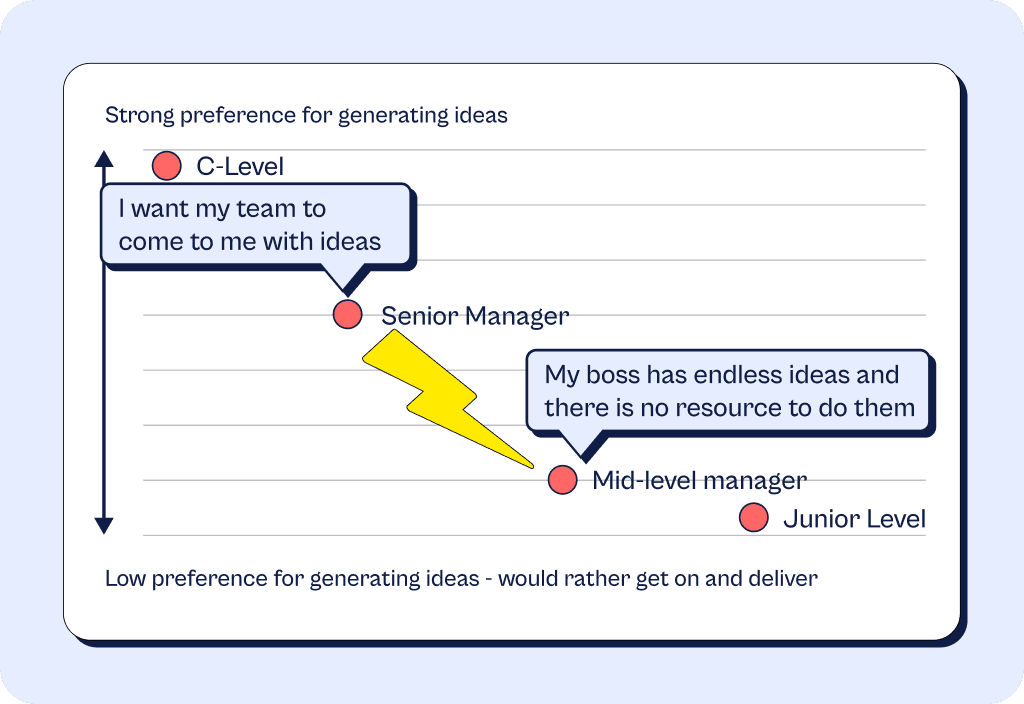
You were hoping for excitement and innovative ideas but you got feedback that they find the rate of change in your business overwhelming. Whether you are a senior executive with 30 years of leadership experience or a new team manager, gaps in understanding and preference between a leader and their team can lead to frustration and stagnation.
While strategy, skills, situations and structures all matter, high-performing teams are built on a foundation of trust and mutual understanding between their leader and the team members. Really getting to know your people and ensuring that they know your motivations and preferences are powerful drivers of sustainable performance, as well as team satisfaction.
You may have a team with a total mix of working styles, or one with an outlier you would like to align more closely with the rest of the group. On the other hand, a team of like-minded individuals might feel like a blessing at first, until you think about blind spots or weaknesses.
The good news is that there are tools available that can help leaders profile individuals, map teams and bridge gaps in understanding to get everyone working together effectively.
Why understanding your team matters
Striving to better understand your team can create a virtuous circle. With a business objective in mind, leaders often start the process but it typically follows that team members evaluate the leader’s perspective in turn and adapt to it.
This reveals the power of the leader-team dynamic, where understanding magnifies potential but misunderstanding amplifies friction. When leaders and team members learn about one another, it increases the likelihood of positive outcomes for individuals and for the organisation. Where alignment does not occur, dissatisfaction and frustration may build, resulting in disengagement and underperformance.
Understanding your team therefore becomes a practical necessity for leaders who want to build productive and resilient teams that surpass business objectives.
The leader–team dynamic in more detail
A positive mutual exchange between a leader and team member can have consequences on different levels. It can lead to concrete outcomes, such as assignment to a project that better suits the individual. This increases their chances of success not only because it plays to their strengths but also because, when people feel that their abilities are understood, commitment and performance tend to improve.
There are also important emotional consequences. When team members experience their manager making a genuine effort to understand them - responding to their needs, preferences or working style - it demonstrates they are valued and respected. This positive feeling strengthens trust and deepens the working relationship.
Over time, these positive exchanges accumulate. Stronger relationships improve communication, reduce unnecessary conflict and create a more supportive environment in which people are willing to contribute discretionary effort. Insight, in this sense, becomes a multiplier of performance.
Understanding the team leader
Team members who understand their leader’s drivers, preferences and pressures are better able to interpret decisions, communicate effectively and adapt their own behaviour where appropriate.
This does not mean suppressing individuality or avoiding challenge. Rather, it enables more constructive dialogue and reduces unnecessary friction caused by misinterpretation. When people understand why a leader behaves in a certain way, they are less likely to personalise issues and more likely to focus on shared objectives.
From an organisational perspective, this mutual understanding strengthens leadership effectiveness and enhances overall team performance.
PROPHET Insight: pivotal relationships
It is critical to focus on key relationships within the group - particularly between the leader and other pivotal roles.
•
Identify the individuals or relationships that are most significant to achieving the team’s objectives.
•
Explore their preferences, the dynamics between them and the impact those dynamics have on the wider team.
Understanding these critical connections often unlocks disproportionate improvements in performance and cohesion.e.e
Avoiding assumptions and perception bias
People differ significantly in their ability to understand, appreciate and convey information about traits and motivations. Yet these skills are fundamental to team interaction. Interactions with new colleagues are particularly prone to misunderstanding but even colleagues who have worked together for years do not necessarily interpret each other’s behaviours accurately.
People are naturally inclined to fill gaps in understanding by making assumptions. We attribute characteristics to others to explain their actions and to predict how they might behave in the future. While this can be efficient, it is also risky. Assumptions are often based on incomplete information and can be distorted by bias.
In leader–team relationships, these misperceptions can be especially damaging. A leader may misinterpret a team member’s behaviour as a lack of commitment, when it is actually a reflection of a different working style. Equally, a team member may perceive a leader as unsupportive, when in fact they are demonstrating trust through autonomy.
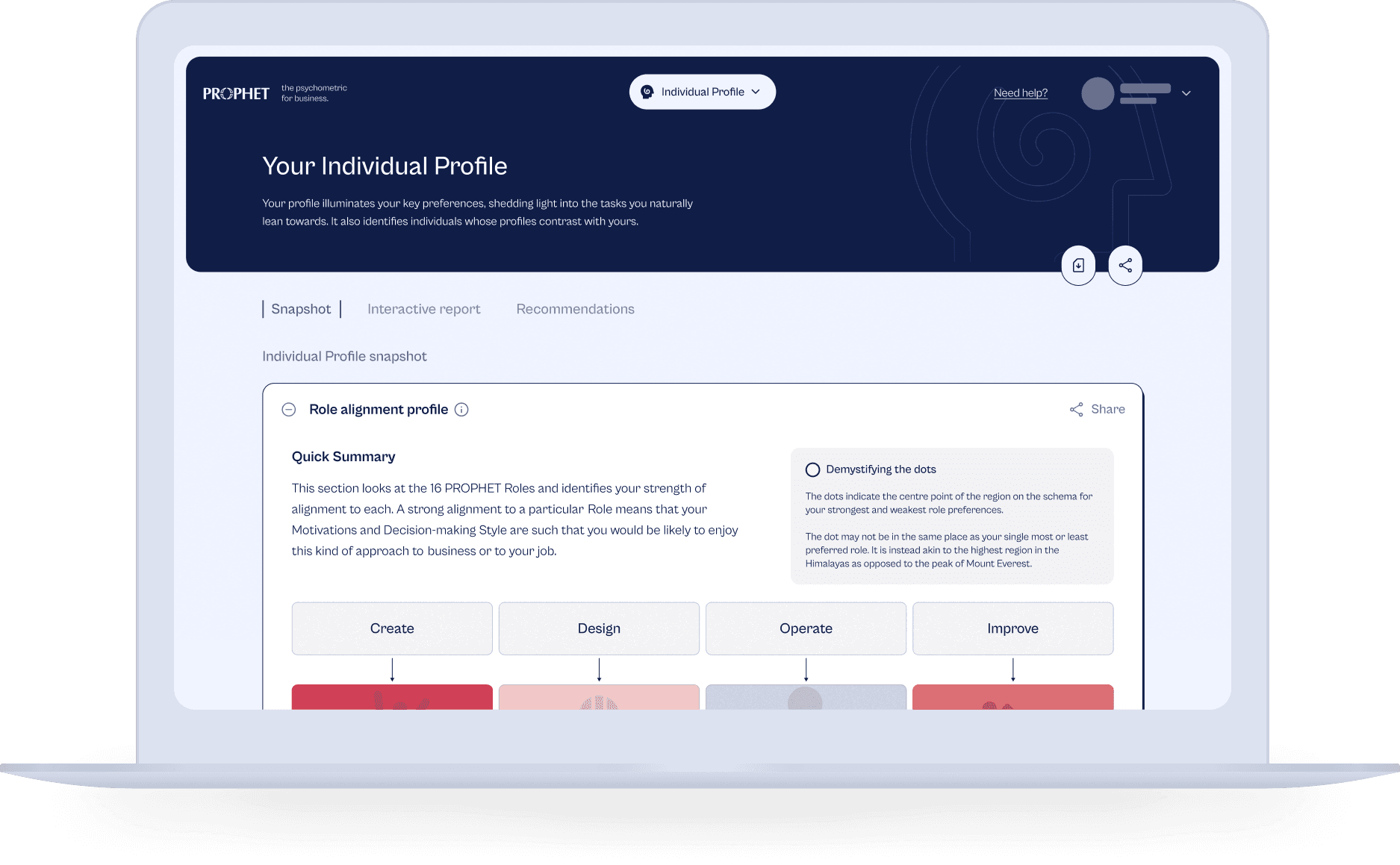
Psychometric profiling provides a neutral shared language and evidence-based insight into behavioural preferences. Tools like PROPHET help teams replace assumptions with understanding. PROPHET is inclusive by design, enabling you to explore traits without resorting to stereotypes or simplistic labels, as well as valuing all working styles. This encourages curiosity rather than judgement and allows teams to discuss differences openly and constructively by providing talking points and evidence-based guidance tailored to your group.
People differ significantly in their ability to understand, appreciate and convey information about traits and motivations. Yet these skills are fundamental to team interaction. Interactions with new colleagues are particularly prone to misunderstanding but even colleagues who have worked together for years do not necessarily interpret each other’s behaviours accurately.
People are naturally inclined to fill gaps in understanding by making assumptions. We attribute characteristics to others to explain their actions and to predict how they might behave in the future. While this can be efficient, it is also risky. Assumptions are often based on incomplete information and can be distorted by bias.
In leader–team relationships, these misperceptions can be especially damaging. A leader may misinterpret a team member’s behaviour as a lack of commitment, when it is actually a reflection of a different working style. Equally, a team member may perceive a leader as unsupportive, when in fact they are demonstrating trust through autonomy.
Psychometric profiling provides a neutral shared language and evidence-based insight into behavioural preferences. Tools like PROPHET help teams replace assumptions with understanding. PROPHET is inclusive by design, enabling you to explore traits without resorting to stereotypes or simplistic labels, as well as valuing all working styles. This encourages curiosity rather than judgement and allows teams to discuss differences openly and constructively by providing talking points and evidence-based guidance tailored to your group.
People differ significantly in their ability to understand, appreciate and convey information about traits and motivations. Yet these skills are fundamental to team interaction. Interactions with new colleagues are particularly prone to misunderstanding but even colleagues who have worked together for years do not necessarily interpret each other’s behaviours accurately.
People are naturally inclined to fill gaps in understanding by making assumptions. We attribute characteristics to others to explain their actions and to predict how they might behave in the future. While this can be efficient, it is also risky. Assumptions are often based on incomplete information and can be distorted by bias.
In leader–team relationships, these misperceptions can be especially damaging. A leader may misinterpret a team member’s behaviour as a lack of commitment, when it is actually a reflection of a different working style. Equally, a team member may perceive a leader as unsupportive, when in fact they are demonstrating trust through autonomy.
Psychometric profiling provides a neutral shared language and evidence-based insight into behavioural preferences. Tools like PROPHET help teams replace assumptions with understanding. PROPHET is inclusive by design, enabling you to explore traits without resorting to stereotypes or simplistic labels, as well as valuing all working styles. This encourages curiosity rather than judgement and allows teams to discuss differences openly and constructively by providing talking points and evidence-based guidance tailored to your group.
Understanding traits in context
Team dynamics are complex. To develop effective working relationships, colleagues need to keep in mind a vast web of interrelated factors. They need to appreciate one another’s unique skills and preferences, as well as considering how they work together as a group, perceiving their individual and collective motivations, all within the context of the particular goals they are trying to achieve together.
A behaviour that is helpful in one situation may be obstructive in another; a preference that appears challenging may be entirely logical when viewed through the lens of an individual’s role or pressures.
When you find a team member is behaving in an unexpected way, ask yourself whether you know:
Team dynamics are complex. To develop effective working relationships, colleagues need to keep in mind a vast web of interrelated factors. They need to appreciate one another’s unique skills and preferences, as well as considering how they work together as a group, perceiving their individual and collective motivations, all within the context of the particular goals they are trying to achieve together.
A behaviour that is helpful in one situation may be obstructive in another; a preference that appears challenging may be entirely logical when viewed through the lens of an individual’s role or pressures.
When you find a team member is behaving in an unexpected way, ask yourself whether you know:
Team dynamics are complex. To develop effective working relationships, colleagues need to keep in mind a vast web of interrelated factors. They need to appreciate one another’s unique skills and preferences, as well as considering how they work together as a group, perceiving their individual and collective motivations, all within the context of the particular goals they are trying to achieve together.
A behaviour that is helpful in one situation may be obstructive in another; a preference that appears challenging may be entirely logical when viewed through the lens of an individual’s role or pressures.
When you find a team member is behaving in an unexpected way, ask yourself whether you know:
•
What makes this team member different from others?
•
What motivates this individual?
•
Which roles cause them to shine?
If you and your team are facing particularly challenging dynamics, a tool like PROPHET provides a structured way to unravel and clarify that complexity at all levels of seniority. PROPHET was purpose-built for business, making its data-led insight and structured guidance reliably credible and relevant.
If you and your team are facing particularly challenging dynamics, a tool like PROPHET provides a structured way to unravel and clarify that complexity at all levels of seniority. PROPHET was purpose-built for business, making its data-led insight and structured guidance reliably credible and relevant.
If you and your team are facing particularly challenging dynamics, a tool like PROPHET provides a structured way to unravel and clarify that complexity at all levels of seniority. PROPHET was purpose-built for business, making its data-led insight and structured guidance reliably credible and relevant.
High-change environments and adaptability
In many organisations, teams are increasingly fluid. Project-based work, matrix structures and fast-growth can all mean that teams are often disbanded and reformed with different people. In these environments, the ability to build effective working relationships quickly is a core competence.
Employees who experience high levels of team change must be able to adapt their behaviour, understand new leaders and collaborate with unfamiliar colleagues. PROPHET supports this requirement by accelerating understanding and providing a framework for discussing differences early, before misunderstandings take root.
Conclusion: the leader-team dynamic as a strategic business advantage
Promoting understanding in your team is not a one-off, ‘soft’ exercise; it is an ongoing process that has a direct impact on productivity and performance.
Leaders who invest in understanding their teams - supported by the right tools - create environments where people feel seen, valued and aligned. In turn, teams become more resilient, adaptable and capable of sustained high performance, the better they understand their leader and other key relationships in the team.
The act of undertaking a profiling exercise in itself reinforces a cycle of cooperation. When people invest time in understanding one another, they signal that relationships matter. This increases the likelihood that colleagues will value one another’s contributions and work more effectively together.
By fostering accurate perceptions and strengthening key relationships, understanding your team becomes a strategic advantage - one that benefits individuals, leaders and the organisation as a whole.
PROPHET Profiling was purpose-built to support this objective, helping organisations turn insight into alignment, and alignment into performance. Find out how by visiting our Team page or filling in an enquiry form.