

The nature of work has changed profoundly in recent years.
Teams are expected to deliver results in environments defined by frequent change, competing priorities and increasing complexity. Leaders are often managing on multiple, conflicting time horizons at once - balancing short-term delivery pressures with long-term capability building and strategic change.
Add to this the realities of hybrid and flexible working, where teams may rarely be in the same place at the same time, and the challenge becomes even greater. Many leaders are also navigating the potential tensions that arise from multi-generational workforces, where different expectations, communication styles and motivations coexist within the same team.
In this context, simply having talented individuals is no longer enough. High performance depends on whether a team is truly playing to its collective strengths - and whether that approach aligns with what it is trying to achieve. Understanding your team’s natural tendencies, how to apply them effectively and when to flex, is now a core leadership skill.
Why understanding your team matters
Every team has strengths and weaknesses. The difference between an average team and a high-performing one lies in how well those strengths are understood, deployed and balanced against the task at hand.
Teams rarely fail because they lack capability. More often, they struggle because their natural way of working does not match the demands of their goals. A team that excels at structure, control and execution may feel uncomfortable when asked to innovate. Conversely, a team full of ideas and energy may falter when consistency, discipline and risk management are required.
Profiling your team’s strengths allows you to:
- Align people and behaviours to the objectives that matter most
- Anticipate where friction or blind spots may emerge
- Flex your leadership style to support the team
Crucially, this understanding must be contextual. Strengths must be considered in relation to what the team is trying to achieve. A behaviour that drives success in one phase of the business lifecycle may actively hinder it in another.
Team archetypes: highly-leading and highly-managing teams
A good place to start understanding how teams operate is through evidence-based team archetypes. While no team is purely one thing or another, many lean more strongly towards a particular type - you can explore all PROPHET’s most distinctive team archetypes on our website. However to illustrate the point, we can investigate the differences between two distinct team types - highly-leading and highly-managing.
It’s noteworthy that:
- Junior teams are 4x more likely to focus on the best approach to execution, ensuring quality, efficiency and effective teamwork; whereas
- Senior teams are 7x more likely to focus on determining the course of action, taking decisions and responsibility.
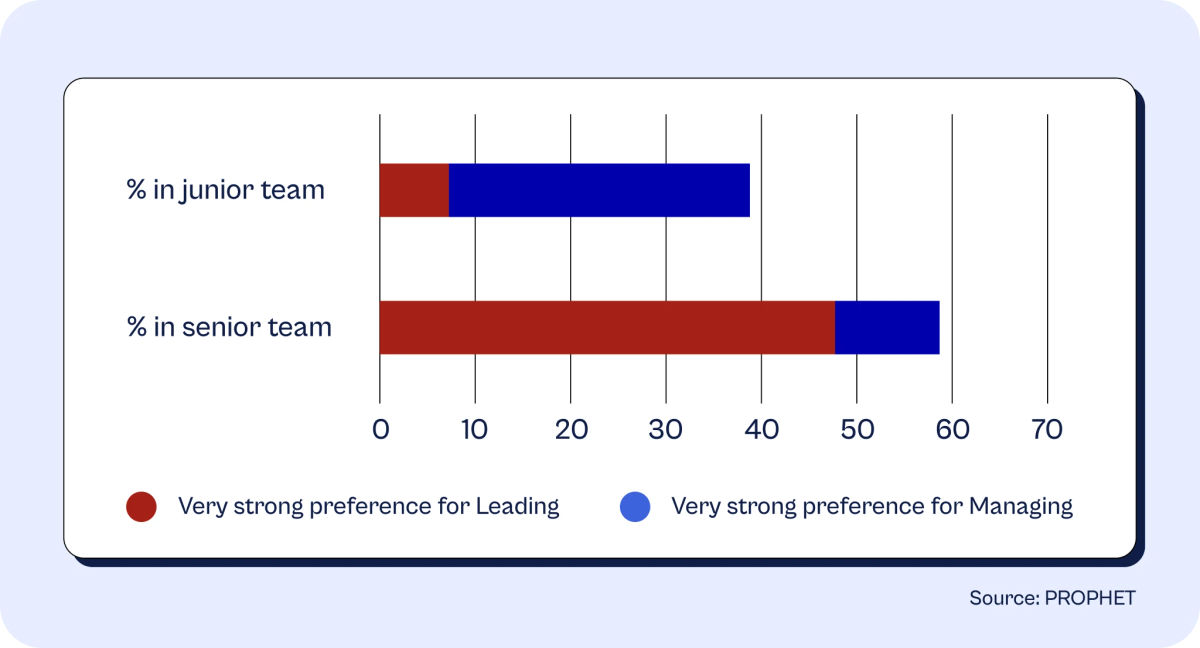
Recognising your team’s preference can provide valuable insight into how it is likely to perform and where it may need support.
The highly-leading team
Leading is defined as being concerned with determining the course of action, taking decisions and responsibility. Leaders come up with ideas or visions that excite people and then develop choices that give those visions substance and impetus.
Highly-leading teams are typically forward-looking, energised and comfortable with ambiguity. They focus on vision, possibility and momentum, often thriving in situations that require change or innovation.
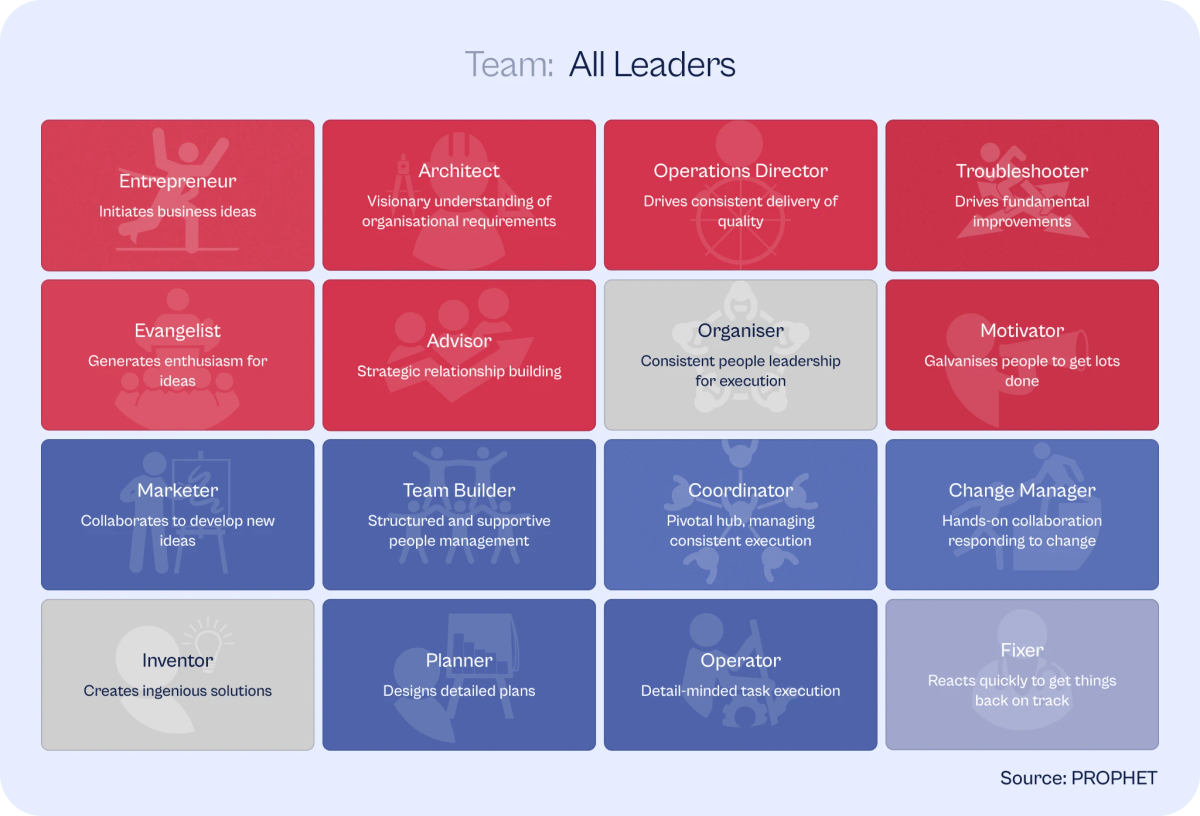
On a good day
- Highly competitive, commercially driven.
On a bad day
- May overlook details and fail to focus on keeping the team working well together.
These teams are particularly effective during start-up, transformation or periods of rapid growth, when direction is still emerging and innovation is essential.
The highly-managing team
A highly-managing team is concerned with the best approach, quality, efficiency or supporting others. Managers tend to view work as an enabling facilitator, involving a combination of people, resources and ideas, interacting to establish strategies, convert vision into solutions and decisions, and to fulfil those plans, responding as required to accomplish an objective.
Highly-managing teams tend to excel in environments that are more reliable and consistent. They value process, clarity and accountability and are often at their best when systems need to run smoothly.
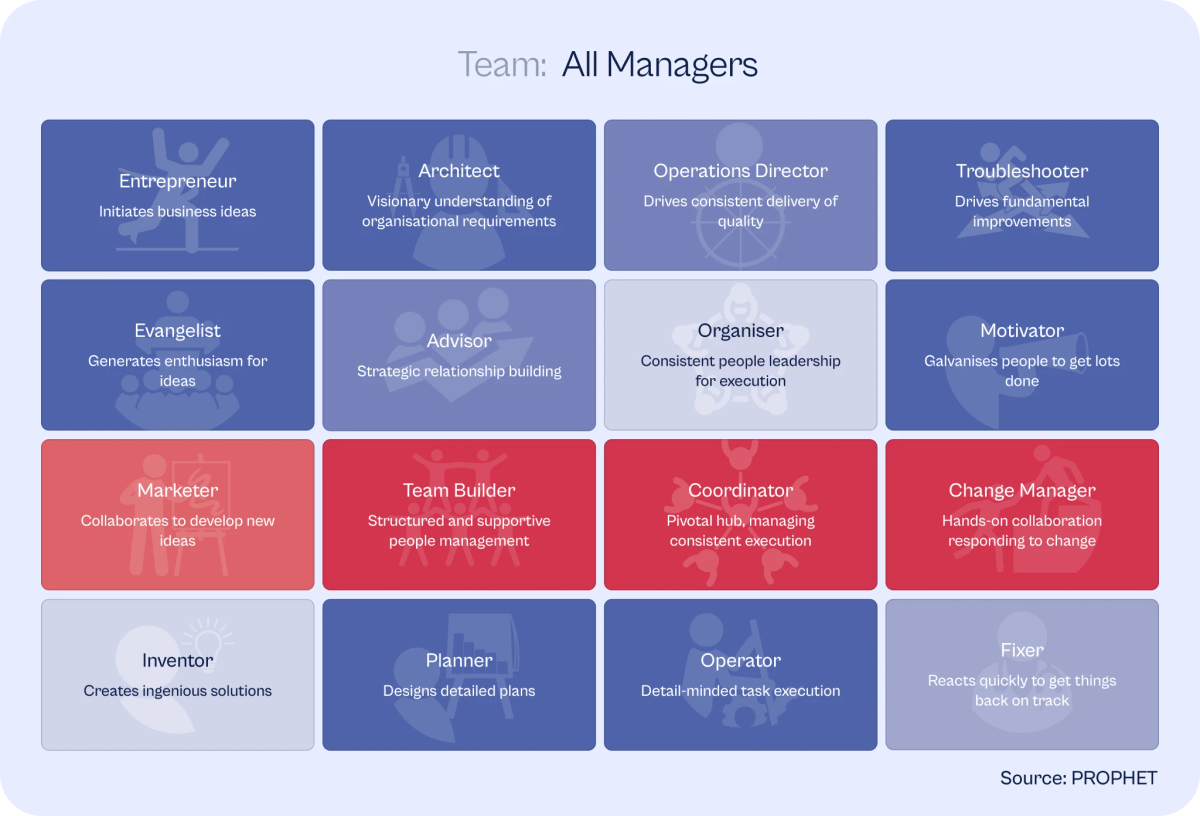
On a good day
- Focus on the best approach, ensuring quality, efficiency and effective teamwork.
On a bad day
- May avoid making difficult decisions.
These teams are particularly effective in more mature phases of the business lifecycle, where stability, scale and operational excellence are priorities. In dynamic environments, a highly-managing approach may limit adaptability.
Matching team strengths to business needs
Teams need to be able to lead and manage simultaneously, and to perform these appropriately to meet a business’s objectives. This idea places emphasis on understanding and leveraging competing strengths. One is not better than the other, rather both are vital to business success.
If a team values or is overly oriented towards leading, it may find that it misses out on supporting, developing or empowering those at more junior levels in the organisation. If a team values or is overly oriented towards managing, it may find that people aren’t driving or pushing for heightened performance and thus don’t fulfil their potential.
The challenge for leaders is twofold:
- To understand where their team naturally sits
- To know when and how to flex that approach
This is where insight, rather than instinct, becomes essential.
Tips for understanding your team
To ensure your team is truly playing to its strengths, consider the following:
1. Profile your team’s approach
Is your team more leading or more managing in its natural style? Or does it fall into another distinct archetype. Profiling provides a shared language and evidence-based insight into how your team prefers to operate, helping to move beyond assumptions or anecdotal impressions.
2. Be clear on the goal
What is your team trying to achieve? Is the priority innovation, stability, growth, turnaround or optimisation? Once the goal is clear, you can assess whether your team’s current approach aligns with it or whether flexibility is needed.
3. Learn how to flex
High-performing leaders do not force teams to be something they are not. Instead, they help teams stretch, introducing complementary behaviours, structures or perspectives that enable success without undermining core strengths. PROPHET provides proven guidance to support this aim.
Playing to strengths, not working against them
In today’s complex and fast-changing workplace, understanding your team’s preferences is no longer optional. Teams that understand their strengths, while flexing intelligently to meet the demands of their goals, are more resilient, engaged and effective.
By recognising team archetypes and applying them thoughtfully, leaders can unlock performance not by doing more, but by working more effectively with the people they already have.
PROPHET Profiling draws on its powerful dataset to provide businesses with evidence-based insights and proven, step-by-step advice on how to ensure your team is working at its best. To find out how, visit our Team page or fill in an enquiry form to order a team profile.