

Is your team too busy admiring its own reflection?
How team alignment can slip from a business goal to an own goal - and what to do next.
How similar are the people in your team? Research suggests that they are probably quite alike; teams (and team leaders) often attract and recruit individuals of a particular type.
Alignment is often cited as the holy grail of organisational health. In business, we want everyone pulling in the same direction. Working with people who value, prioritise and are motivated by the same things may feel positive, largely because it makes day-to-day life easy. On the surface, a team that moves in unison feels like a well-oiled machine. Decisions are fast, conflict is low and the cultural "vibe" is comfortable. However, with deeper thought, some obvious problems start to emerge. For senior leaders, this sense of comfort might actually be a red flag.
The science of sameness: The ASA model
It isn't an accident that your team feels like a tribe. The phenomenon is rooted in what psychologist Benjamin Schneider (1987) identified as the Attraction-Selection-Attrition (ASA) model.
The theory is simple but powerful:
- Attraction: people are naturally drawn to organisations that appear to share their values and working style.
- Selection: organisations tend to hire people ‘who fit the culture,’ which often subconsciously means ‘people who are like us.’
- Attrition: those who don’t fit - the outliers who challenge the status quo - eventually leave, which in turn further solidifies this pattern.
Further research, by Kristof-Brown, Zimmerman, & Johnson (2005), confirms that over time, this cycle creates a significant congruence between employee personalities and the organisational identity.
Even social networking, designed to broaden our horizons, often does the opposite. It connects us with like-minded peers, reinforcing our biases and influencing us to think even more alike.
By the time a company reaches a certain size, it has often accidentally engineered out the very diversity of thought it needs to survive a changing market.
When frustration turns into attrition
In a team of people who mostly think alike, outliers can find themselves shouting into a void. When they can’t influence the group’s direction, they stop trying.
As Wood et al. (1994) discovered, a minority that fails to win over the majority will eventually comply just to keep the peace. But compliance isn't commitment. These individuals often harbour resentment, feel their value is unrecognised and eventually disengage.
When your "different" thinkers leave, your team bias doesn't just stay the same - it actually strengthens. And you lose the perspective that could have saved you from your next big mistake.
Homogeneity as a business risk
You might ask, "If we're working fast and everyone seems happy, what’s the issue?" But too much conformity can tip over into complacency. When a team is mostly very similar, an outlier’s need to belong may override his or her instinct to disagree.
In this context, even if a team decision feels like a consensus, it might not be. Research into group dynamics suggests that the “2/3 majority rule” usually dominates (Strasser, 1999). If at least two-thirds of the room agrees, the remainder - the minority voice - is effectively silenced. People with differing views are more likely to find it difficult to contribute to the discussion, while the emboldened majority may not consider the preferences of the minority, how it may be determining the group’s decisions or whether its tendencies are in fact optimal for the business.
This can lead to:
- Blind spots: a team that excels at innovation might miss operational system failure (or vice versa!)
- Echo chambers: flawed strategies go unchallenged because no one wants to be seen as negative when everyone else seems to agree.
- Overconfidence: just because nobody disagreed it doesn't mean you made the best decision; it just means the majority won.
- Silent sabotage: where the minority ignores the decision because they didn't feel part of the process and don’t agree with the outcome.
PROPHET Tip: Insight into group traits can highlight possible biases and encourage groups to examine how their collective tendencies affect their decisions.
Practical steps: moving from passive consensus to active inclusion
Uncovering the reality in your team is the first step towards improvement. Following up with open and inclusive discussion is key to engaging all your team members in the solution.
How do we stop the “majority wins” cycle?
1. The power of “process fairness”
Research by Tyler, Degoey, & Smith (1996) found that if people feel they have been allowed to express and justify their preference, they are less likely to disengage and will usually accept a decision they originally didn’t want. As a leader, your job isn't to make everyone happy; it's to ensure everyone is heard.
2. Moving from passive agreement to active buy-in
In their work on the social consensus model of group decision-making, Sager and Gastil (2006) argue that true consensus is a voluntary rule a group chooses to follow.
A team of highly competitive, closed-minded individuals will struggle to reach a consensus because they view “winning the argument” as the goal. On the other hand, when a team agrees at the start of a discussion that it won’t move forward until everyone's perspective is integrated, it changes the power dynamic, helping to prevent the most senior person or the loudest majority from steamrolling quiet outliers.
The model identifies that certain traits, specifically extraversion, agreeableness and openness to experience, are the engine of a healthy team. People with these qualities are more likely to generate a relatively high level of supportive communication, in turn leading to the group’s voluntary adoption of the consensus decision rule.
PROPHET tip: by identifying who in your team naturally possesses these “supportive communication” traits, you can designate them as facilitators. They become the bridge-builders who ensure that the minority view is heard and folded into the final strategy.
3. Actively valuing outliers
PROPHET values all working styles so it can stimulate a balanced and neutral discussion, encouraging teams to listen to and incorporate the views of outliers. With a team profile, you can visualise the collective and individual strengths and preferences of your team, and attract any outliers into the centre of the conversation where their unique insight belongs.
How PROPHET is designed to help you balance the cycle
Business is cyclical: teams need to create, design, operate and improve. However, most teams are naturally stronger in one or two of these areas and light in others.
PROPHET can profile your team to identify the overall preference for these different business stages, as well as activities on a more granular level. This will vary according to the group, for example teams from different levels, functions or industries will tend to have their own typical profiles. So an ‘outlier’ will depend on the norms of any given group. Tensions will differ between the ‘norm’ in that particular team and the profile that is most different.
At the most senior levels:
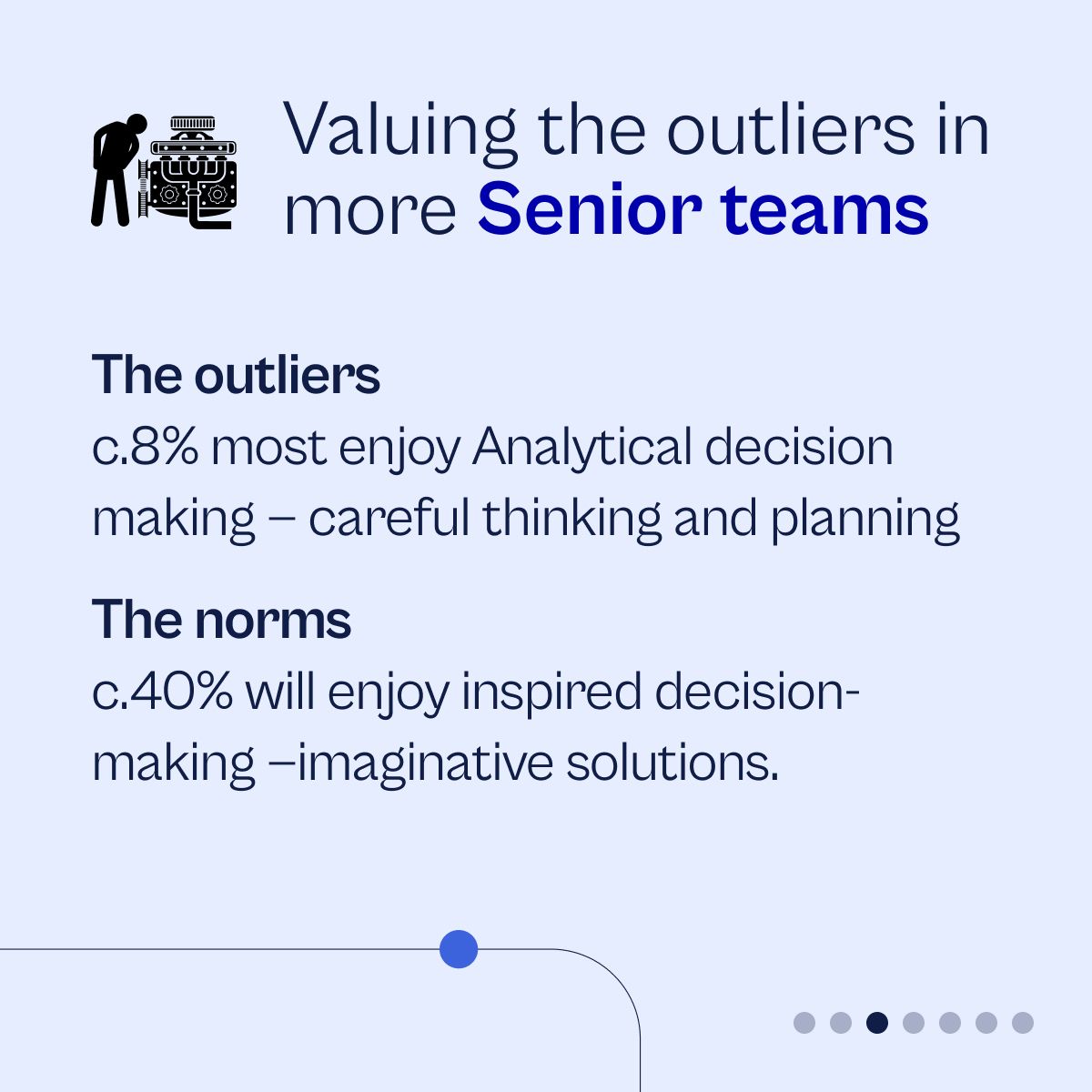
- An outlier may be someone who really enjoys an analytical approach as only 8% of senior execs indicate a strong preference for this
- The norm: their colleagues are more likely to enjoy Inspired thinking (c. 40% have a strong preference).
At more junior levels
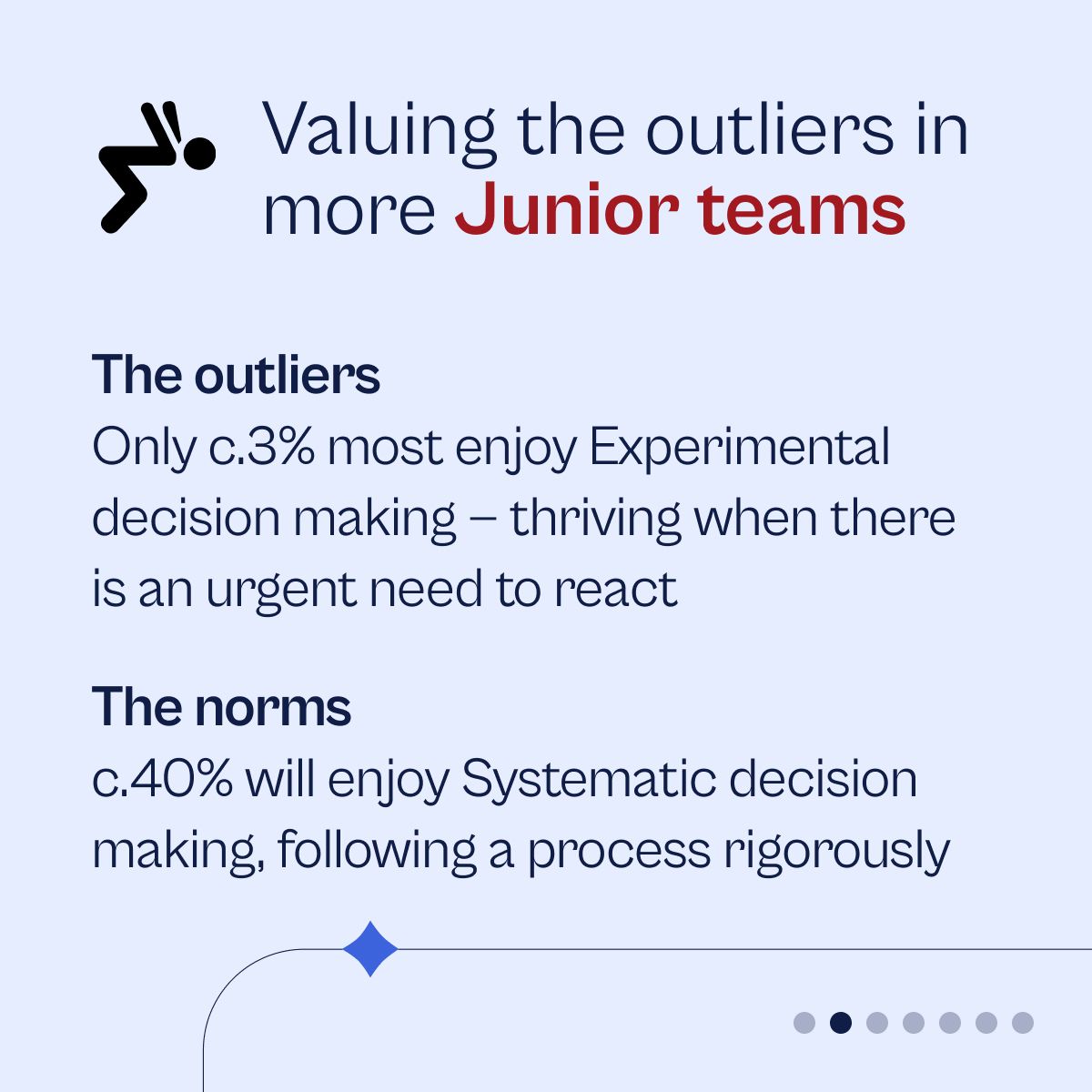
- An outlier may be someone who thrives in urgent situations, enjoying pressure and reacting quickly
- The norm: their colleagues are more likely to enjoy more systematic working, following a well defined process (c. 40% prefer this)
PROPHET helps you:
- See the sameness: we provide the data on your group’s collective preferences, making the norm visible.
- Avoid groupthink: we give leaders and outliers the language to explain why a different view has real commercial value.
Conclusion
A homogeneous team can be a vulnerable team. To stay competitive, senior leaders must move beyond the comfort of the ‘hall of mirrors’ and embrace the productive friction that comes from diverse working styles.
If you would like to hear more about how, with PROPHET’s insight and actionable advice, you can make your team more inclusive, more considered and more effective as a result, please complete an enquiry form.