

Every team is made up of lots of different people, with different strengths, preferences and ways of working.
That diversity isn’t just inevitable, it’s essential. To navigate the full business lifecycle, organisations need a mix of thinkers and doers, planners and innovators, challengers and stabilisers.
But here’s the part that’s often missed: when people are able to play to their strengths - and do work they genuinely enjoy - the effect is amplified. Performance improves, confidence grows and success becomes self‑fulfilling. People who experience success more often are more engaged, more committed and far more likely to stay in their jobs.
Making the most of team members’ strengths isn’t just about creating a feel‑good environment. It’s about unlocking performance and directing it where it creates the most value.
What we’re up against
This matters now more than ever. Engagement levels across the global workforce are alarmingly low.
According to Gallup’s State of the Global Workplace: 2023 Report:
- 59% of employees are “not engaged” - often described as quiet quitting
- While a further 18% are “actively disengaged” - or loud quitting
That suggests a staggering 77% of the global workforce is not thriving at work - and the cost is not abstract. Gallup estimates that disengagement drains roughly $8.8 trillion from the global economy, equivalent to around 9% of global GDP.
Behind those numbers are people who feel underused, misunderstood or stuck doing work that doesn’t suit how they operate best.
Why alignment matters (especially at different career stages)
Feeling valued and successful is motivating for anyone but it doesn’t have the same drivers for everyone. Career stage plays a major role.
Junior employees typically crave:
- Clear structure
- Direction and feedback
- A sense that they are learning and progressing
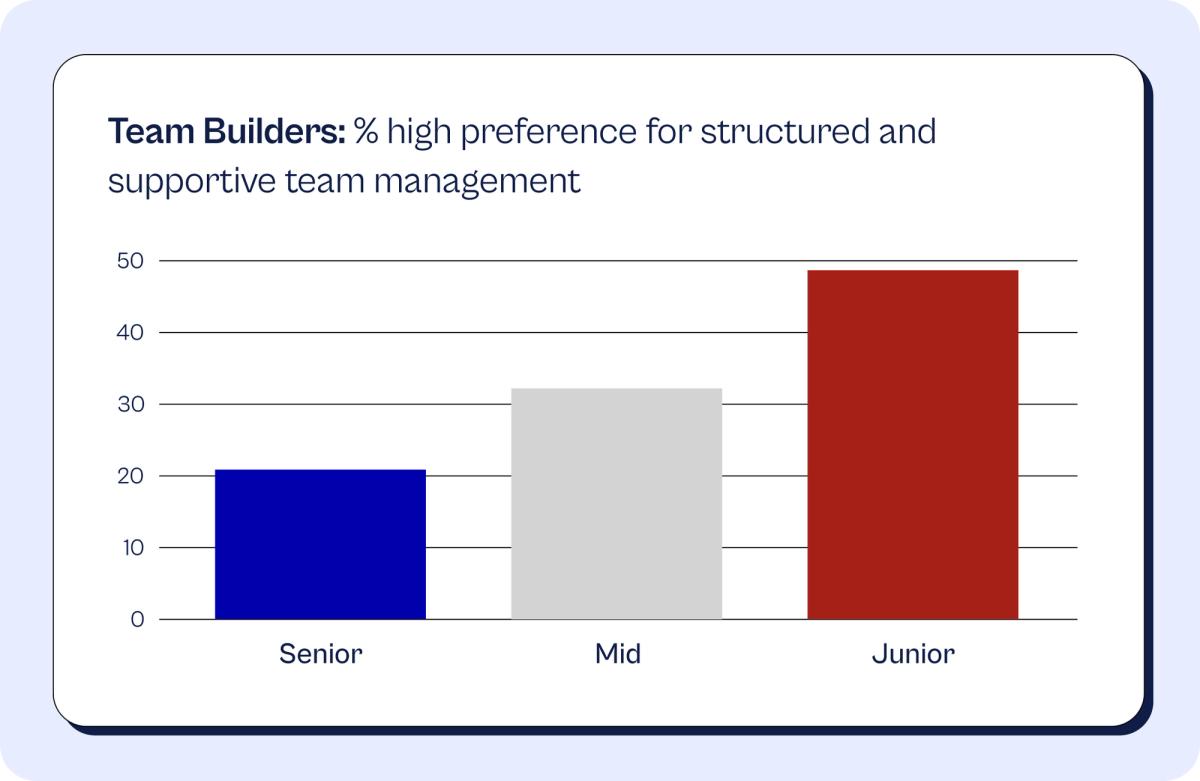
When these needs aren’t met, even high potential individuals feel both exposed and stuck. Yet these team members are often among the most important to motivate and retain. They form the future capability of the organisation.
Senior employees, on the other hand, often value autonomy and meaningful challenges. Treating everyone the same - or assuming motivation works uniformly - leads to frustration and resentment.
Understanding what success feels like for different people is an important part of getting the best out of them.
Why playing to strengths improves performance
Psychological research has long shown that behaviour is shaped by outcomes. Homans (1958) proposed that behaviour followed by positive or valuable outcomes is more likely to be repeated. In other words, when people experience success - as they define it - they naturally do more of what led to that success.
Applied to work, this means that allowing people to express their natural tendencies is often the most direct route to sustained motivation and contribution. It’s a win-win for the business and the individual.
Personality traits as powerful motivators
Viewing personality traits as having motivational force also explains why alignment improves performance.
Kristof‑Brown et al. (2005) examined the idea of needs–supplies fit - the extent to which a role or organisation meets an individual’s preferences and needs. When that fit is high, employees are more satisfied, more committed and more effective.
Earlier work by Murray (1938), and later research by Tett and Burnett (2003), found that jobs and organisational contexts that allow people to express their traits are inherently rewarding. They fulfill psychological needs that drive effort and persistence.
This matters because most jobs cover many different roles, and those roles evolve as a company moves through the business lifecycle. Many employees juggle a wide range of activities, at least some of which sit outside their natural comfort zones. Without awareness and support, this creates strain rather than stretch.
The goal isn’t to eliminate discomfort entirely. It’s to ensure that people spend enough time operating in ways that energise them, so they can cope effectively with the parts of the role that don’t.
Putting the theory into practice
So how do you actually match people to their strengths?
When executives or team leaders understand their own behavioural preferences, they can work more effectively, as well as leveraging other team members in ways that are more likely to result in satisfaction and success. All working styles are valuable, especially when they are aligned with roles and business goals.
PROPHET is a profiling tool designed to make work more fulfilling - and effective as a result - by helping team leaders and individuals understand how people think, behave and find motivation.
Just as importantly, PROPHET recognises that behaviour that leads to success in one phase of the business cycle may be less effective in another.
The underlying belief is simple: organisations get more from people when work feels enriching to them. A rewarding outcome doesn’t have to be a promotion or a bonus. It can be as simple as:
- Using strengths rather than operating in a role that doesn’t suit
- Being recognised and valued for your unique approach
- Experiencing progress without unnecessary friction
Practical ways to play to your team’s strengths
Turning insight into action is where the real value lies. Here are three tips to help leaders better understand their teams and align that understanding to business success.
1. Start with leadership
Use PROPHET to help executives identify behaviours that are more likely to bring about positive outcomes for them personally. This helps them be more flexible so that they can be successful across a wide range of tasks and objectives.
2. Align roles with natural preferences across the business cycle
Use PROPHET to explore how individual traits fit different functions, pressures and phases of growth. When people repeatedly have positive experiences at work, performance becomes more sustainable over time.
3: Guide your team with insight and purpose
PROPHET’s Team Builder focuses on structured and supportive people management - a critical enabler for making the most of team strengths. Structure creates clarity; support builds confidence. Together, they allow strengths to show up consistently.
The bottom line
Making the most of team members’ strengths isn’t about avoiding challenge. It’s about directing effort where it has the highest return.
When people feel they have a high chance of success, they engage. When they engage, they commit. And when commitment grows, organisations perform better - commercially, socially and culturally.
If you would like to find out how to turn the differences in your team into high performance, fill out a contact form or visit our team page.