

Transforming workplace pressure into a diamond advantage
A guide for high-performing teams
Workplace pressure is a global reality. According to a survey by APA, 80% of employees report experiencing stress. More importantly, over half of those say it affects their performance, leading to communication break-down, mistakes, increased risk or burn-out. But it doesn’t have to.
The difference between a team that fractures and one that is transfigured can lie in understanding what happens to people operating under stress. While we might view "grace under pressure" as an innate character trait, research suggests it is actually a measurable cognitive process.
The challenge for leaders is not to eliminate pressure but to manage the predictable behavioural shifts that occur when stakes are high. By understanding what happens when people are under pressure, organisations can maintain strategic alignment when it matters most.
The psychology of regression: why people revert to type
When cognitive load increases due to deadlines or high-stakes objectives, our brains’ architecture changes how we process information. According to Daniel Kahneman’s System 1 / System 2 framework, deliberate, strategic thinking (System 2) requires significant mental resources. Pressure depletes these resources, forcing individuals back into System 1: fast, automatic and instinct-driven responses.
This shift is further explained by the Yerkes-Dodson Law, which dictates that beyond an optimal stress threshold, performance degrades. This degradation specifically manifests as a loss of complex, learned behaviours.
Research into behavioural consistency suggests that 70 - 90% of people revert to their natural type under sustained pressure. In a professional context, this means that collaborative or inclusive “intentional behaviours” developed in training are often the first to disappear, replaced by an individual's most basic, default traits.
The trap of short-termism and self-interest
People working in business, especially executives, often have to weigh short-term interests against long-term ones. Different time horizons can affect which of their natural traits people exhibit. In turn, this might result in decisions that are not always optimal for the team or business.
- Temporal discounting: Delayed gratification takes effort. Much like the findings in Mischel’s well-known “marshmallow test” for children, adults working under stress downgrade the value of future outcomes in favour of immediate rewards (Joireman, Balliet, Sprott, Spangenberg & Shultz (2008)).
- Reduced cognitive capacity: Research by Kumashiro, Finkel and Rusbult (2008) indicates that time-pressured individuals are less likely to consider broader business requirements, instead falling back on self-interested actions that offer immediate satisfaction or relief.
- The erosion of cooperation: Cooperation is intrinsically linked to time. As noted by Axelrod (1984), people are more likely to cooperate if they foresee long-term interdependence. When pressure forces a present-orientated mindset, team members may neglect relationship-oriented behaviours, particularly with external contractors or across departmental silos, because they lose sight of the long-term value of the partnership.
Navigating the default response
The primary risk of operating under pressure, then, is that decisions become sub-optimal and interactions become less constructive.
When entering a high-pressure phase, leaders can take steps to equip the team to navigate the situation without fracturing.
PROPHET provides a simple framework to understand each person in the team’s natural preferences, helping to predict what will happen under stress, as well as providing evidence-based advice on how to avoid negative outcomes.
Strategies for intervention
Here are some practical adjustments to ensure performance remains high:
- Cognitive awareness: Simply being aware of one's own default traits can help an individual to recognise when they are slipping into self-interested or purely transactional behaviours.
- Meeting agenda adjustments: If a team’s profile suggests they are prone to skipping strategic reflection under pressure, you can formally amend meeting agendas to force a “System 2” pause.
- Structural turn-taking: To prevent dominant “System 1” personalities from overshadowing the team's collective intelligence, leaders can implement formal turn-taking to ensure all perspectives are weighed against business goals.
Building long-term behavioural resilience
A critical takeaway is that one-off training is insufficient for high-pressure environments. Because learned behaviours are the first to be abandoned under stress, any desired team behaviour must be practiced until it becomes genuinely habitual.
Key Insight: If a behaviour hasn't been practised enough to become an automatic default, it will not survive a crisis. Sustained, repeated practice is the only way to bridge the gap between ‘knowing’ and ‘doing’, when the heat is on.
Conclusion: from reflex to strategy
In the modern corporate landscape, pressure is an inevitable constant. For team leaders, the goal is to ensure that this stress does not lead to a default state of short-termism and friction.
By using insight into team dynamics, leaders can move from reactive firefighting to proactive management. When we understand how we - and our colleagues - are likely to revert to type, we can put the necessary guardrails in place to ensure that even under extreme pressure, the team remains focused on long-term business excellence and robust working relationships.
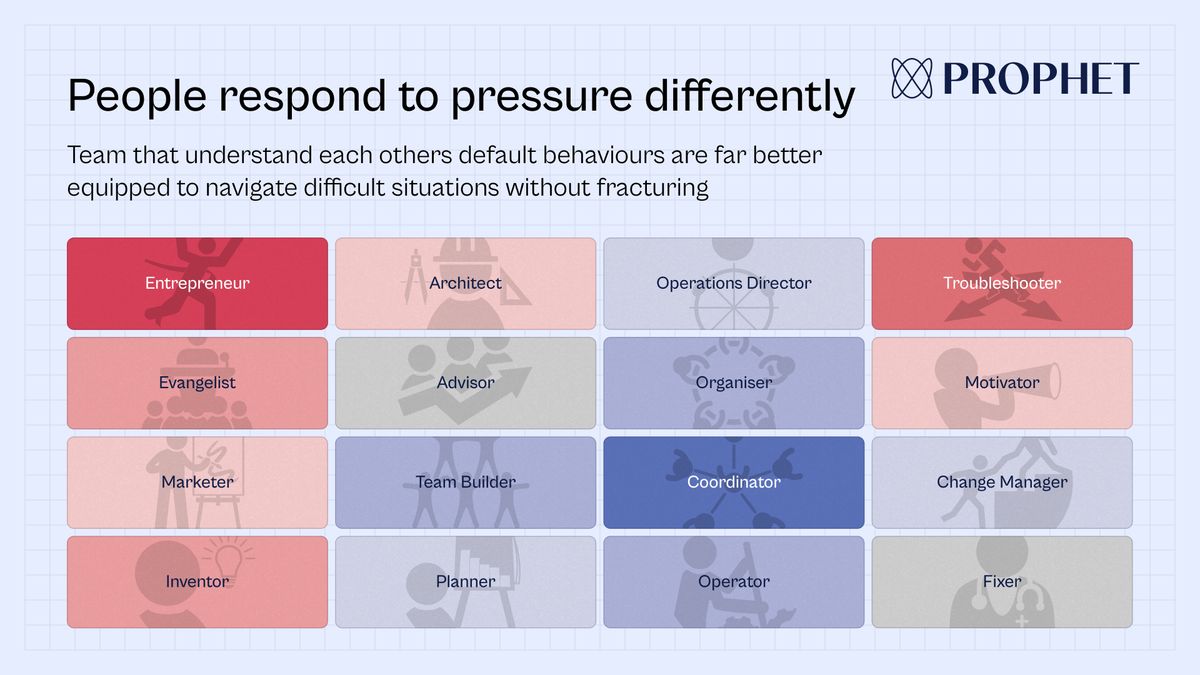
How is your team’s behaviour under stress impacting your long-term objectives? Find out more about how PROPHET can help by filling in an enquiry form today.