

How team leaders can strike the right balance between a structured or a flexible approach
Understanding and applying evidence-based insights from team archetypes
Leading a team in 2026 is exhausting. Senior managers are simultaneously:
- navigating AI’s evolution from shiny, new tool to the engine room of the modern team;
- vetting the integrity of the data their teams use, as the line between human-authored and machine-generated content becomes invisible;
- fighting a reskilling war, where the technical skills required for most roles are now evolving more quickly than traditional training can keep pace with;
- managing radical flexibility, where team members work different hours, in different time zones, using different tools; and
- feeling the pressure to protect their team's deep work time, while being asked to deliver real-time responsiveness by the C Suite.
All this, while finding it harder than ever to “read the room”, often through a screen, leading to a rise in undetected mental health struggles and quiet quitting 2.0. Leaders need all the help they can get.
How better understanding your team makes the difference
Thanks to technology, the path from idea to execution is shorter than ever. Teams need to get comfortable with adjusting their approach according to the challenge they’re facing in the moment. Increasingly, they are looking to leadership to help guide them through this cycle. However, the rate of change is so rapid, many leaders are feeling unsteady too. Evidence-based team archetypes provide a solid foundation on which to build understanding and action.
Team archetypes: flexible and structured teams
This is our second article exploring team archetypes and how they can guide you to lead your team (learn about highly-leading versus highly-managing teams here).
While real teams are always complex, layered and made up of different individuals, many lean towards a particular type. Understanding which type your team is, and what that means for their working style, equips you with a blueprint for how to respond to different challenges. This article looks at structured and flexible teams.
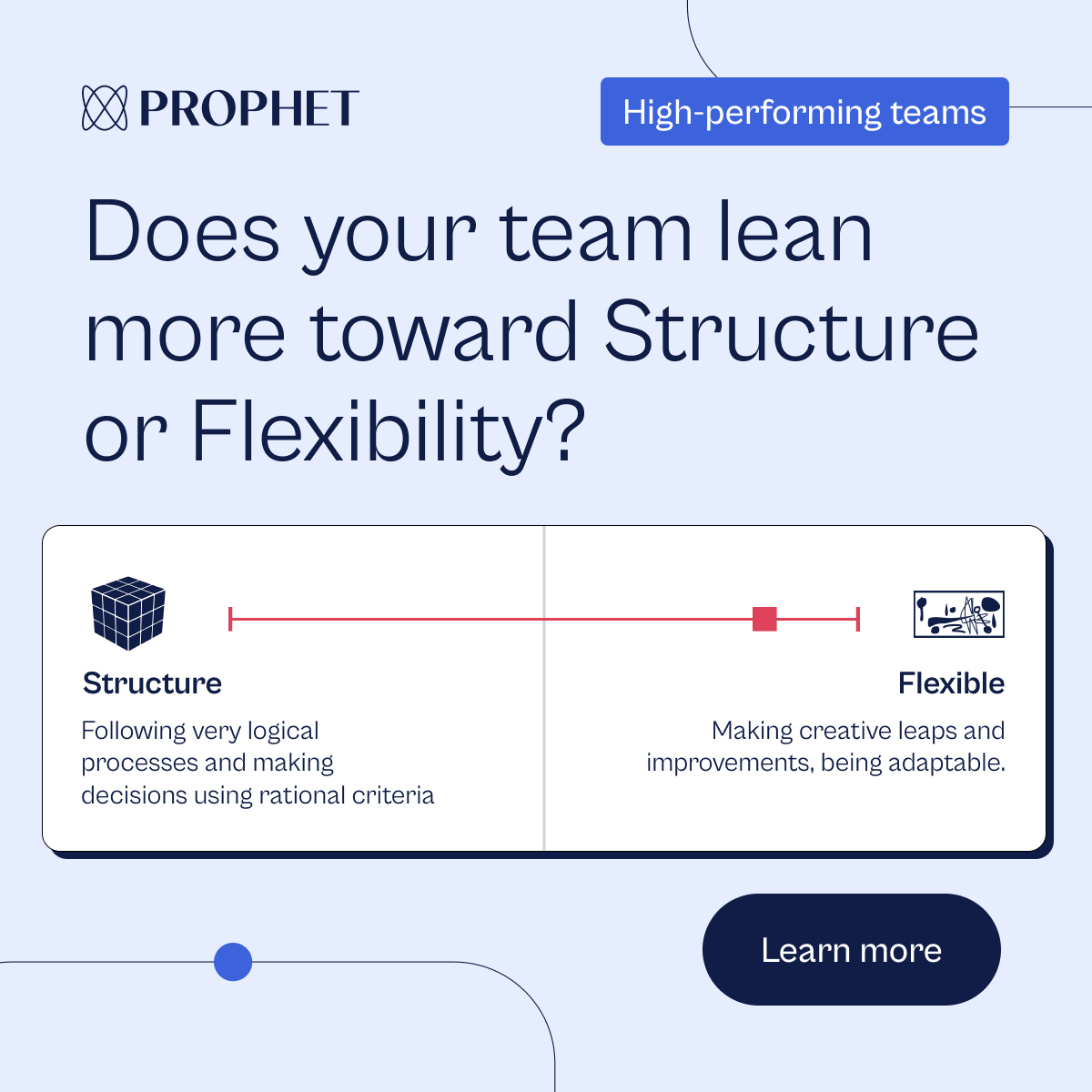
PROPHET’s Structured / Flexible inclination looks at whether people prefer to follow logical thought processes, or are adaptable and make creative leaps.
The Flexible team
The Flexibility inclination isn’t just about agility or openness to change. It’s the ability to think differently (McCrae, 1987) - or rather, creatively (McCrae & Costa, 1997; Feist, 1998). Within the PROPHET framework, the Flexible inclination manifests in two powerful ways: inspired and experimental decision-making. These aren't just gut feelings; they are the tools of transformation.
Individuals strongly aligned to this inclination are:
- Resourceful & insightful: they see what others overlook (John & Srivastava 1999),
- Intellectually curious: they ask "why?" until they find a better "how?" (McCrae, 1996).
- Attitudinally fluid: They don’t get stuck in existing processes (McCrae, 1994).
A Flexibility inclination allows a team to:
- Bridge the gap: it frees the mind to connect seemingly unrelated concepts - the “Eureka!” moments that create massive leaps forward.
- Drive evolution: whether it’s a tiny incremental tweak or a grand-scale transformation, Flexibility is the permission slip to improve.
- Navigate the unknown: it provides the psychological safety to experiment, fail fast and eventually find the better approach.
The Flexible inclination is therefore critical for businesses seeking to initiate change, whether that is transformation, evolution or incremental adjustments.
Flexible teams
On a good day: Bring creativity, ingenuity, and a compelling vision for change.
On a bad day: May avoid routine tasks and concrete planning.
The Structured team
A Structured inclination, on the other hand, is about following logical thought processes and making decisions using rational criteria. This Structure turns the creative, innovative vision into reality.
Researchers like Fleishman (1973) defined “initiating structure” as the art of defining roles and carving out clear, repeatable processes. It’s the difference between a team that’s busy and one that’s effective. PROPHET’s inclination for Structure is about adhering to plans and procedures in moments when compliance and reliability are critical for business success.
Structure-oriented leaders focus single-mindedly on the task at hand (Bass & Stogdill, 1990), making them the heavy hitters when it comes to reaching performance milestones.
When teams lean into a Structured inclination, they are:
- Organising resources: ensuring people and tools are deployed with maximum efficiency.
- Building reliability: acting as the anchor in high-stakes moments where compliance and precision are non-negotiable.
- Eliminating passive leadership: not shirking responsibility or letting projects drift; these leaders stay deliberate, self-disciplined and dependable.
Structure in businesses means people have the plans and objectives, as well as the infrastructure, to execute a vision in a systematic and monitored way. An inclination for Structure helps organise resources effectively and efficiently.
Structured teams
On a good day: Carefully evaluate new ideas or problems to determine the best approach
On a bad day: Risk missing opportunities by overanalysing instead of acting
When tensions emerge
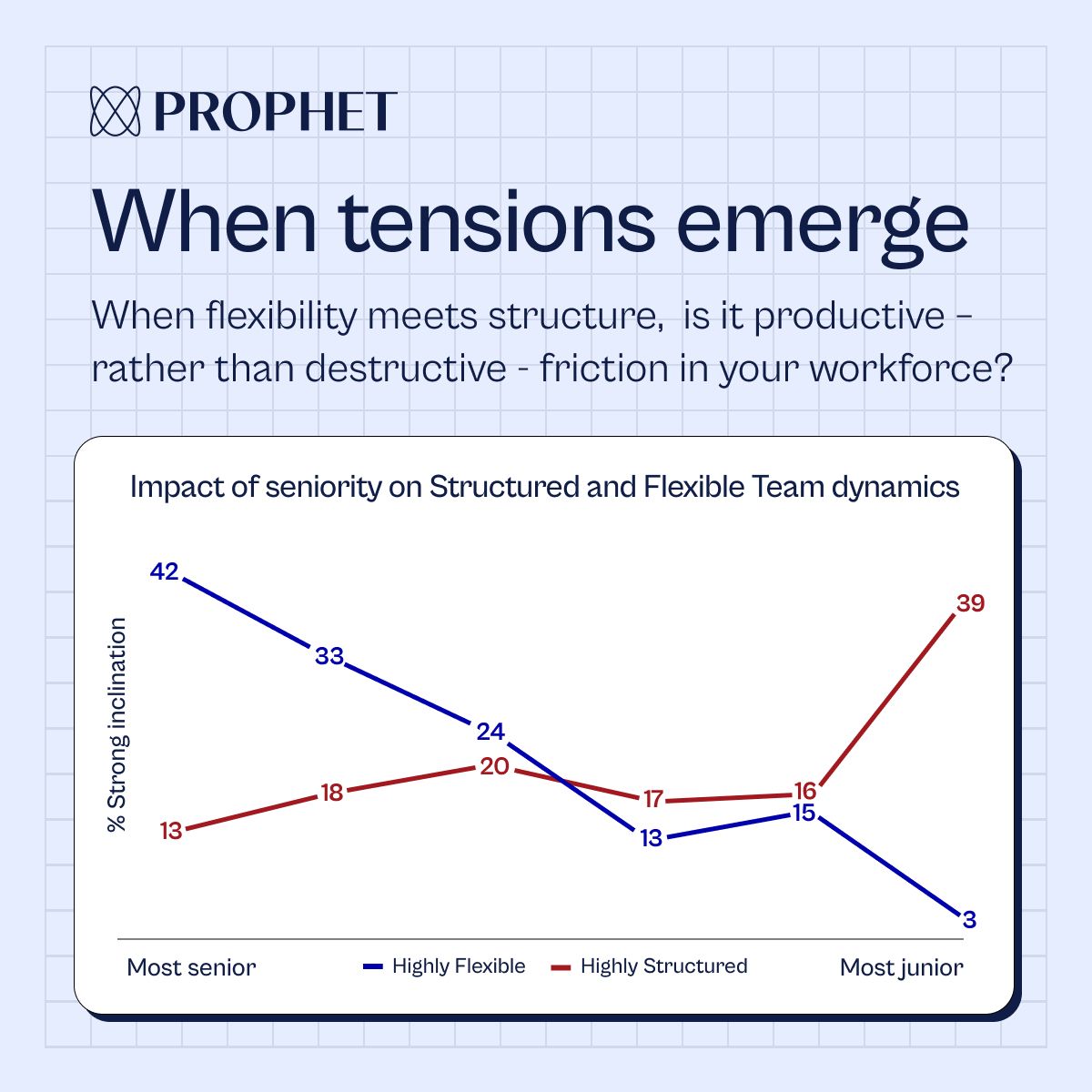
When flexibility meets structure, it can be one of the most productive friction points in the workplace. In many teams, that conflict is likely to occur between more senior and junior members - or indeed between the leader and the rest of the team. Flexibility asks “why are we still doing this the old way?”, while structure demands “why are we changing the plan again?”
- Senior teams are significantly more likely to be highly flexible (42% of senior execs have a strong preference for flexibility)
- Junior teams strongly value structure (39%of junior execs have a strong preference for structure)
Here are some strategies for turning this tension into competitive advantage.
1. The "why" vs. "how" hand-off
Now that you understand these archetypes, you can assign roles based on these natural inclinations during different project phases.
- Phase 1 (The vision): Let the Flexible team members lead. Their divergent thinking is perfect for brainstorming and "what if" scenarios.
- Phase 2 (The build): Hand the baton to the Structured team members. Their natural approach will ensure ideas actually become a reality without the project drifting.
2. Shared Language: compliance vs. creativity
Conflict can happen when leaders don't clearly distinguish between moments of critical compliance (where Structure is non-negotiable) and creative evolution (where Flexibility is encouraged).
- Tip: At your next kick-off meeting, label tasks. If a task is fixed, explain the need for Structure. If a task is fluid, Flexible team members get the licence to experiment.
- The result: Structure feels secure and Flexibility feels heard.
The bottom line
In the modern business landscape, Structure and Flexibility aren't rivals, they’re partners. Neither is better than the other; instead, their value depends on the mission at hand.
As Fleishman (1995) argued, the effectiveness of Structure is actually “curvilinear” - or in plain English: there’s a point of diminishing returns.
- An overly Structured approach: If a leader leans too hard into Structure, the team stops thinking and starts merely following. When a rigid process becomes the boss, you lose the agility to spot a golden opportunity or pivot before a crisis hits.
- Too much Flexibility: Conversely, unbridled Flexibility is a short gallop to chaos. Without a structural anchor, teams lose sight of the horizon and brilliant initiatives are often abandoned for the next big thing before they’ve even had a chance to deliver value.
Striking the Balance
The most effective leaders in 2026 are those who know exactly when to lock down and when to let loose. It’s about understanding your team, reading the market and responding to the moment to decide which approach is most appropriate.
Ready to find your team's equilibrium?
If this look into team archetypes has sparked your Flexible inclination to try something new, contact us to discover how PROPHET can map your team’s unique profile and provide a clear, step-by-step roadmap to turning your natural dynamics into a strategic advantage.